

Young Changemakers Fellowship
NOAA


Official websites use .gov
A .gov website belongs to an official government organization in the United States.

Secure .gov websites use HTTPS
A lock () or https:// means you’ve safely connected to the .gov website. Share sensitive information only on official, secure websites.
The eeBLUE Young Changemakers Fellowship will not run in the 2025-2026 school year. For information on the first two cohorts of the fellowship, please see below, or reach out to young.changemakers@noaa.gov for more information.
The eeBLUE Young Changemakers Fellowship (YCF) is a program dedicated to collaborating with and empowering the next generation of ocean and environmental leaders.
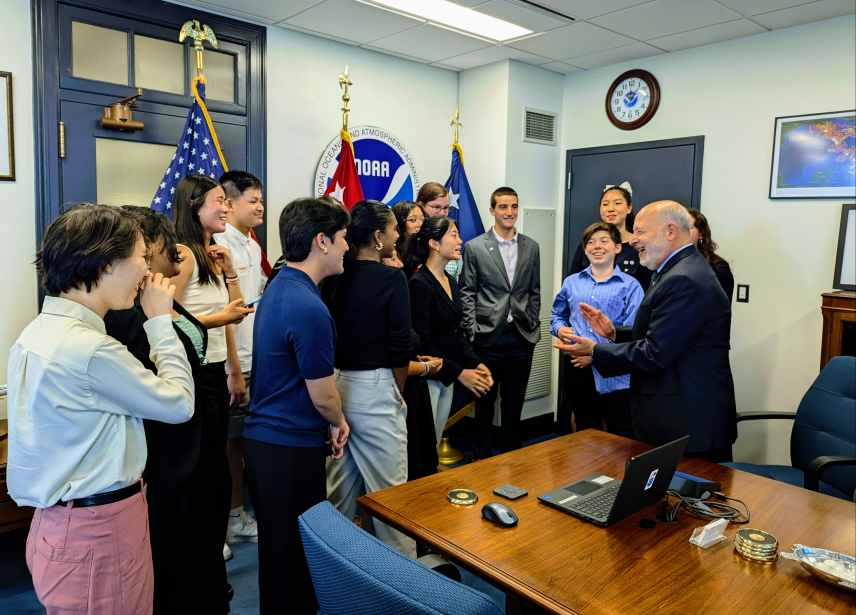
Through YCF, high school students from the United States, U.S. territories, and tribal nations learn to create change in their home communities. The changemakers also provide NOAA leadership with their perspective on large-scale issues such as climate change, ocean issues, community resilience challenges, and more.
.jpg "A group of 13 people, nine high school students and four adults, smile at the camera. They are standing on a rooftop patio in Washington, DC, with the Washington Monument in the background. (Image credit: NOAA)")
Fellows take part in an in-person summit in D.C. in the summer and virtual meetings throughout the school year. These meetings include everything from community engagement workshops and science communication training to roundtable discussions with NOAA leadership.
Together, these opportunities help fellows turn their passion for ocean and environmental topics into concrete action, all while helping NOAA better understand the perspectives of young people.
This fellowship is a joint effort between NOAA and the North American Association for Environmental Education (NAAEE) offsite link. It is run through the eeBLUE partnership offsite link, which works to further environmental and science literacy to build more resilient communities nationwide.
It is not an overstatement to say that this has been a life-changing experience.
In return for full program participation, each fellow receives:
Eight high school students completed the fellowship as part of the 2023-2024 cohort, the pilot year of the program. Each fellow led their own community-based action project, ranging from environmental literacy campaigns to electronics recycling drives to local community resilience workshops.
The 2024-2025 cohort is composed of 15 high school students hailing from 11 different states and two territories. They will complete their fellowship in June 2025.
9a67.jpg?h=edc284fa&itok=24ef7lYK)
.jpeg)