  • Home
  • Weather
  • Climate
  • Ocean & Coasts
  • Fisheries
  • Satellites
  • Research
  • Marine & Aviation
  • Charting
  • Sanctuaries
  • Education
  • News and features
  • Tools & resources
  • About our agency
U.S. flag

An official website of the United States government

Here’s how you know

Dot gov

Official websites use .gov
A .gov website belongs to an official government organization in the United States.

HTTPS

Secure .gov websites use HTTPS
A lock (LockA locked padlock) or https:// means you’ve safely connected to the .gov website. Share sensitive information only on official, secure websites.

Find your local weather
Change location:
  • News
  • Tools
  • About
 
 
NOAA mobile logo
NOAA logo National Oceanic and Atmospheric Administration U.S. Department of Commerce


Breadcrumb

  1. Home
  2. Offices
  3. Office of Education
  4. About the Office of Education
  • Office of Education home
  • About the Office of Education
    • About the Office of Education
    • Contact us
    • News and stories
  • Bay Watershed Education and Training (B-WET)
    • Bay Watershed Education and Training (B-WET)
    • Apply
    • Awards
      • 2023 B-WET awards
      • 2022 B-WET awards
      • 2021 B-WET awards
      • 2020 B-WET awards
      • 2019 B-WET awards
      • 2018 B-WET awards
      • 2017 B-WET awards
      • 2016 B-WET awards
      • 2015 B-WET awards
      • 2014 B-WET awards
      • 2013 B-WET awards
      • 2012 B-WET awards
      • 21st CCLC awards
    • Resources
      • MWEE Guide
      • MWEE resources
        • MWEE explainer
      • Grantee resources
      • National evaluation
      • Communication toolkit
        • B-WET background information
        • News blast
        • Press release
        • Social media content
    • Partnerships
      • Nita M. Lowey 21st CCLC
    • Impacts
      • B-WET timeline
      • B-WET videos
  • Environmental Literacy Program
    • Environmental Literacy Program
    • Grants
      • Apply
      • Explore awards
      • Competition summaries 2015-2022
        • 2022-2023 ELP grants
        • 2020-2021 ELP grants
        • 2018-2019 ELP grants
        • 2016-2017 ELP grants
        • 2015 ELP grants
      • Completed project summaries
    • Impacts
    • Partnerships
    • Resilience hub
      • Environmental Literacy Program's resilience assets
      • Grantees' education resources
  • Ernest F. Hollings Undergraduate Scholarship
    • Ernest F. Hollings Undergraduate Scholarship
    • About Senator Hollings
    • Prospective scholars
      • Frequently asked questions for applicants
    • Current scholars
      • Frequently asked questions for current scholars
      • Class of 2024-2026 Hollings scholar profiles
      • Class of 2023-2025 Hollings scholar profiles
    • Scholarship alumni
      • Class of 2022-2024 Hollings scholar profiles
      • Class of 2021-2023 Hollings scholar profiles
    • NOAA mentors
      • Frequently asked questions for NOAA mentors
    • Impacts
      • Impacts
      • Hollings Preparation Program Internship: 2019-2025
  • José E. Serrano EPP
    • José E. Serrano EPP
    • EPP Science Centers
      • 2021/2022 awards
        • NOAA Center for Atmospheric Sciences and Meteorology II (NCAS-M II)
        • NOAA Center for Coastal and Marine Ecosystems II (CCME II)
        • NOAA Center for Earth System Sciences and Remote Sensing Technologies II (CESSRST II)
        • NOAA Living Marine Resources Cooperative Science Center II (LMRCSC II)
      • 2016 awards
        • NOAA Center for Atmospheric Sciences and Meteorology
        • NOAA Center for Coastal and Marine Ecosystems
        • NOAA Center for Earth System Sciences and Remote Sensing Technologies
        • NOAA Living Marine Resources Cooperative Science Center
      • Awardee resources
      • Center quarterly highlights
      • NOAA Experiential Research and Training Opportunities (NERTO)
        • Frequently asked questions on NERTO for CSC Students
        • Frequently asked questions: For mentors of EPP/MSI graduate students and NERTO
      • EPP Graduate Fellowship Program
      • Competition
    • EPP Undergraduate Scholarship
      • Prospective EPP undergraduate scholars
        • Prospective scholars: Frequently asked questions
      • Current EPP undergraduate scholars
        • Current scholars: Frequently asked questions
        • 2023-2025 EPP/MSI undergraduate scholars
        • 2024-2026 EPP/MSI undergraduate scholars
      • Undergraduate scholarship alumni
        • 2022-2024 EPP/MSI undergraduate scholars
        • 2021-2023 EPP/MSI undergraduate scholars
        • 2020-2022 EPP/MSI undergraduate scholar profiles
        • 2019-2021 EPP/MSI undergraduate scholar profiles
        • 2018-2020 EPP/MSI undergraduate scholar profiles
        • 2017-2019 EPP/MSI undergraduate scholar profiles
        • 2016-2018 EPP/MSI undergraduate scholar profiles
        • 2015-2017 EPP/MSI undergraduate scholar profiles
    • NOAA mentors
    • EPP impacts
      • Education and Science Forum
      • EPP alumni
        • EPP/MSI alumni at NOAA
    • About EPP
      • Archived programs
    • About Congressman José E. Serrano
  • Science On a Sphere (SOS)
    • Science On a Sphere (SOS)
    • SOS Explorer
    • SOS Users Collaborative Network
      • Evaluations & best practices
      • Members
      • Workshops & meetings
        • 2022 SOS Virtual Workshop
        • 2020 Virtual Workshop
        • 2018 SOS Workshop Presentations
        • 2017 SOS Workshop Presentations
    • SOS in Silver Spring
      • Reserve
  • Coordination
    • Coordination
    • Aquaculture literacy
      • Mini-grant awards
        • 2024 mini-grant awards
        • 2021 mini-grant awards
      • Resources
      • Impacts
    • Citizen science
      • Be a citizen scientist
      • Community of practice
      • Information collections
      • News and stories
    • Coastal Ecosystem Learning Centers
      • Members
      • Priorities
        • Aquaculture literacy initiative
        • Youth engagement
      • Workshops
      • Podcast: NOAA and the Octonauts
        • Episode 1: The Whale Shark
        • Episode 2: The Undersea Storm
        • Episode 3: The Walrus Chief
        • Episode: Hiatus Announcement
        • Episode: We're Back! Teaser Trailer
        • Episode 4: Flying Fish
        • Episode 5: Giant Squid
        • Episode 6: The Crab and the Urchin
        • Episode 7: The Eel Ordeal
    • Communication and outreach
      • Outreach frequently asked questions
      • Hands-on science activities
        • A drop in your hand: Water stewardship
        • Art activities
        • Boat building challenge
        • Hands-on activity: How does sea foam form?
        • How marine mammals stay warm
        • Hydrographic surveying: Mapping the sea floor
        • Ocean acidification and dry ice
        • Ocean motion: Wind-driven currents
        • Plate tectonics and lava lamps
        • Tying science to history: Making rope by hand
      • Regeneron International Science and Engineering Fair
        • Judging for the NOAA award at regional and state science fairs
        • NOAA Special Award winners at Regeneron ISEF
      • Science Olympiad
        • Resources for 2025 Science Olympiad: Meteorology
        • Resources for 2025 Science Olympiad: Dynamic Planet
        • NOAA Dynamic Planet and Meteorology Award winners
      • EPP/MSI and Hollings scholar blog
    • NOAA Education Council
      • About
      • Accomplishments
      • Monitoring and evaluation
        • Monitoring resources
        • Evaluation resources
      • Reports
      • Strategic planning
    • Young Changemakers Fellowship

Office of Education news and stories

Share:
Share to Twitter Share to Facebook Share by email Print
Collaborative versus independent research: Lessons from my NOAA internship
September 5, 2024
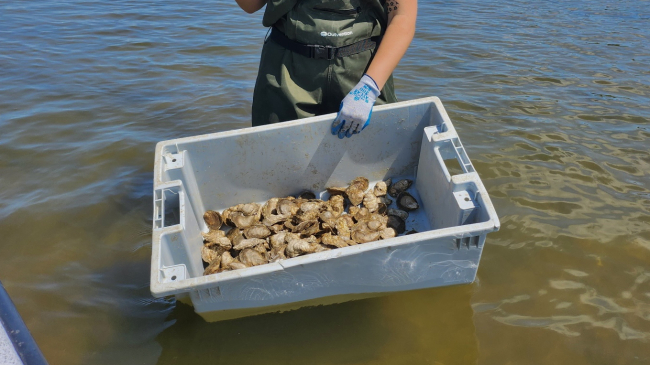
Kennedy wears waders and is standing in water up to her knees. In one hand she holds an oyster and the other rests on a plastic bin holding more oysters that is floating in front of her.
Seeing stars: A day in the life of a Hollings scholar at Kodiak Laboratory
August 22, 2024
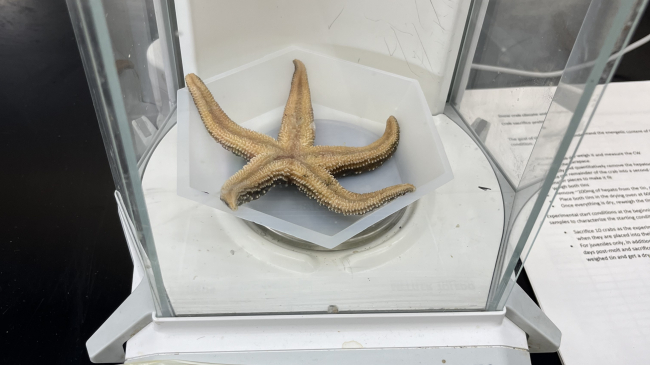
A sea star in a plastic weigh dish on a laboratory balance. The balance reads "38.2441 g."
Immerse yourself in Earth and space: Get SOS Explorer
June 5, 2024
Visualize data on a virtual globe using this free software for your PC!
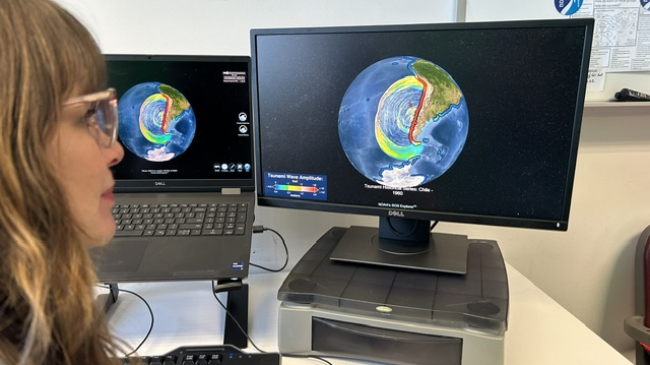
A person sits at a desk looking at a laptop screen and a computer monitor. The screens show a globe displaying a tsunami dataset in SOS Explorer.
Participate in science with NOAA
April 1, 2024
More than 500,000 people volunteer to help us learn more about Earth, and you can too!
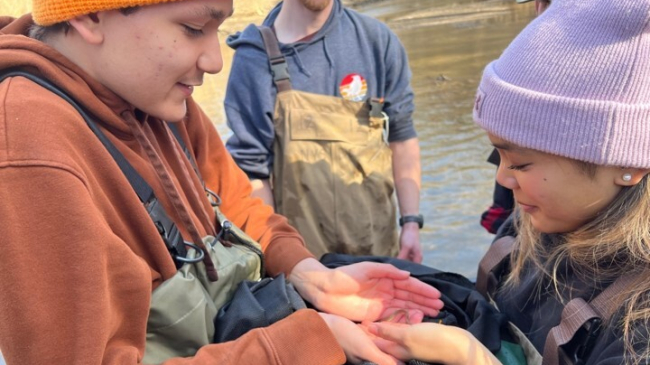
Volunteers Eva Lagdamen and Benjamin Sankar are standing in the waters of an estuary, wearing waders, and show the camera a small eel, approximately the length of a finger, that they found in the river.
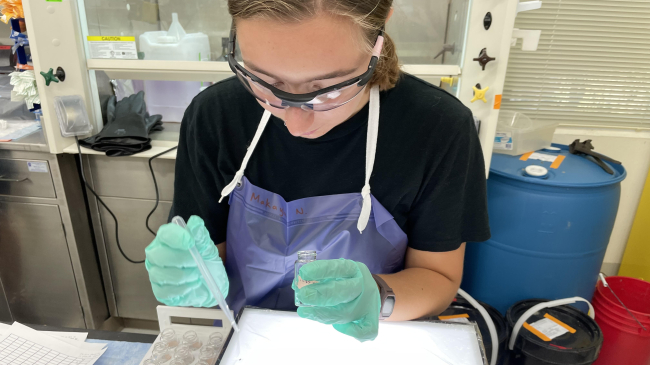
Gaining professional connections and lab skills: An internship on the impact of 'forever chemicals' on grass shrimp
November 21, 2023
Makayla stands at a lab bench, looking down at a lab tray that looks to contain shallow water. She holds a transfer pipette in one gloved hand and a sampling vial in the other. She wears protective goggles and an apron.
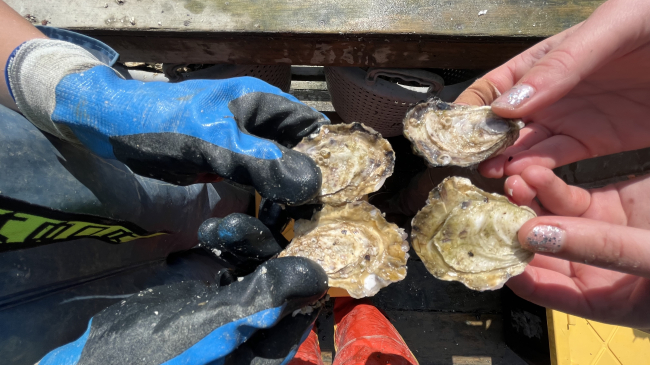
The case of the missing females: Channeling Nancy Drew during my summer internship
November 17, 2023
A top-down view of two pairs of hands. Each hand holds an oyster.
Researching life in the deep scattering layer: A poster from my Hollings internship
November 17, 2023
A digitally illustrated poster that shows a water column represented as visually noisy acoustic data. On top of the water, a NOAA vessel rests in the water. The deep scattering layer is drawn about a third of the way down the water column. Towards the bottom of the poster, the backscattering response implies sea floor bathymetry that varies in depth. An ROV located in the deep scattering layer is connected by a wire to the NOAA vessel. Gelatinous marine organisms are drawn in the ROV's line of sight.
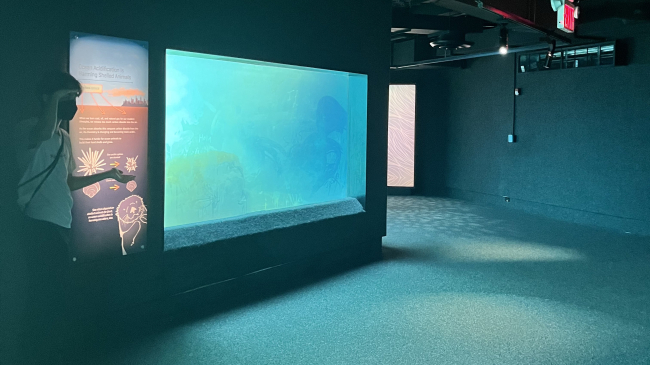
Communication and community: My internship contributing to a new wave of ocean acidification education
November 17, 2023
Isaac stands next to an ocean acidification display in an empty room. He holds his hand over his eyes and shrugs the other hand as if looking around in confusion.
Illustrating internship research findings of trash use by birds
November 17, 2023
One person's trash is another bird's building material
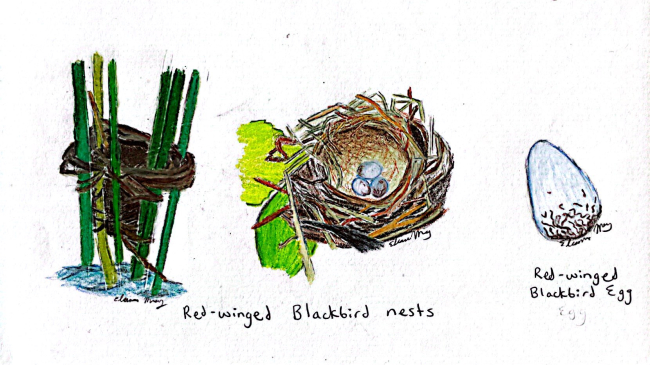
Drawings of the birds nests and eggs of gray catbirds and red-winged blackbirds. The gray catbird nests are cup-like and look to be made with with twiggy materials, leaves, and pieces of plastic or paper trash. Their egg is bright blue. There are two types of red-winged blackbird nests: One is weaved around a bundle of reeds. The other is a cup-like nest made of twiggy material. The egg is off-white with irregular dark squiggly lines marking the lower third of the egg.
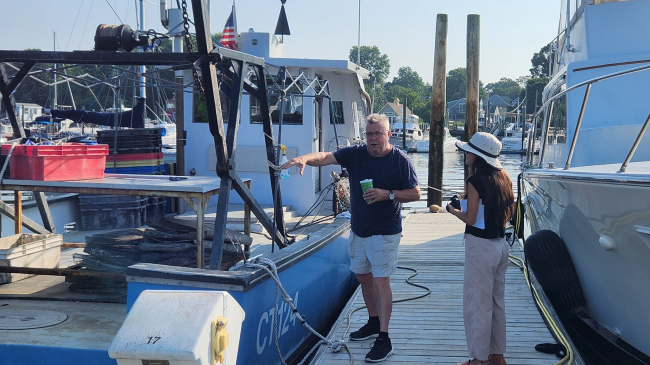
Photo essay: Reflecting on interviews with oyster farmers during my internship
November 17, 2023
Grace and the oyster farmer stand on a dock with boats docked on either side. Grace looks at the oyster grower, who is speaking and gesturing towards his boat.
  • Go to first pageFirst
  • Go to previous pagePrevious
  • Page 1
  • Page 2
  • Currently on page 3
  • Page 4
  • Page 5
  • Page 6
  • Page 7
  • Page 8
  • Page 9
  • …
  • Go to next pageNext
  • Go to last pageLast
View all
Last updated March 14, 2025
Have a comment on this page? Let us know.
Office of Education
Contact us!
Stay connected to Office of Education
Connect to Office of Education on Twitter
Connect to Office of Education on Facebook
Connect to Office of Education on Instagram
Connect to Office of Education on YouTube
Connect to Office of Education on LinkedIn
NOAA Home
Science. Service. Stewardship.
  • News
  • Tools
  • About
  • Resources for Tribal & Indigenous Communities
  • Bipartisan Infrastructure Law (BIL)
  • Inflation Reduction Act (IRA)
  • Protecting Your Privacy
  • FOIA
  • Information Quality
  • Accessibility
  • Guidance
  • Budget & Performance
  • Disclaimer
  • EEO
  • No-Fear Act
  • USA.gov
  • Ready.gov
  • Employee Check-In
  • Staff Directory
  • Contact Us
  • Need Help?
  • COVID-19 hub for NOAA personnel offsite link
  • Vote.gov
Stay connected to NOAA
NOAA on Twitter NOAA on Facebook NOAA on Instagram NOAA on YouTube
Back to top