
How do oyster farmers choose what type of oyster to grow for the market? This decision is especially difficult in Puget Sound, where farmers must balance traits such as meat quality and size with risks of mortality that are worsening due to climate change. To help with these decisions, Hollings scholar Kiran Bajaj spent her 2024 summer internship developing an online tool as part of a joint project between the Northwest Fisheries Science Center, the University of Washington, and the company Baywater Shellfish. Farmers can use Kiran’s tool to weigh the costs and benefits of growing two types of Pacific oysters (Crassostrea gigas) based on the environmental conditions at their farm. Throughout her internship, Kiran also had the chance to visit multiple farms and take data in the field.
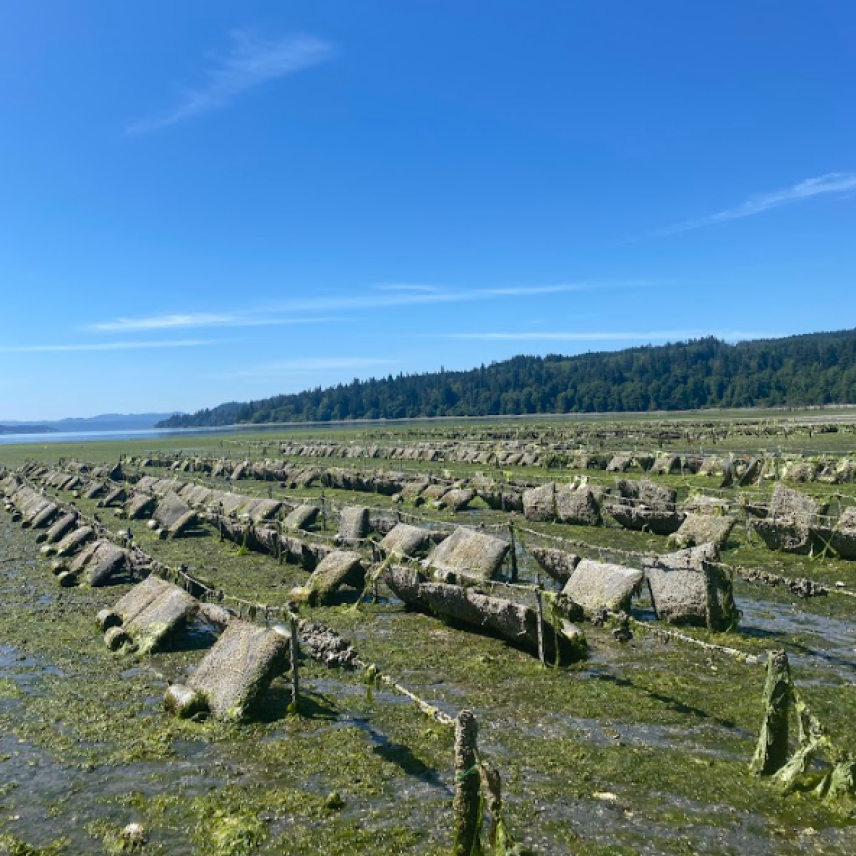
Two choices for farmers: triploid and diploid oysters
Triploid oysters are individuals with three sets of chromosomes instead of the usual two sets found in naturally occurring diploids. Having three sets of chromosomes renders triploids sterile. Since they don’t reproduce, they can allocate more energy to growth and grow to market size quickly, making them popular among farmers. Triploids are also marketable in summer, which is when many people want to eat oysters. During that same time, diploids are reproductive and unsatisfying for some customers. Despite their benefits, triploids are vulnerable to “triploid mortality” events, likely brought on by a combination of stressors such as high temperature and low oxygen.
Decision support
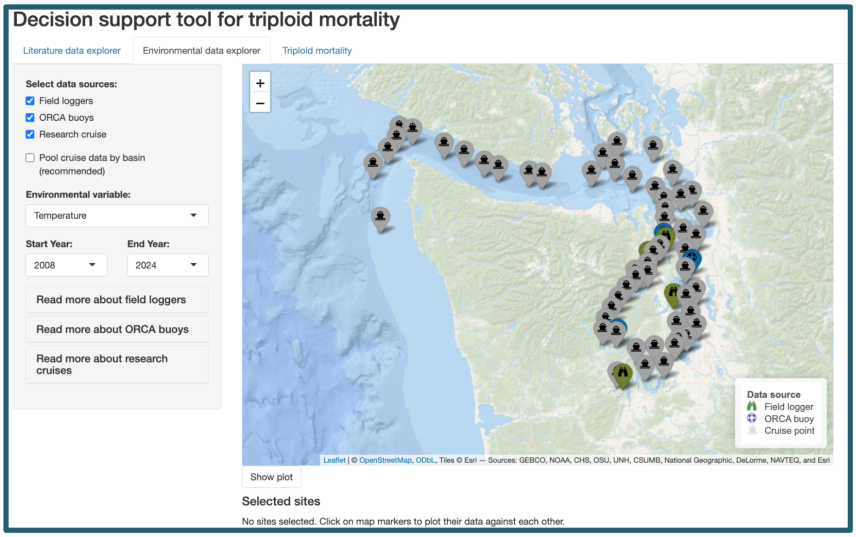
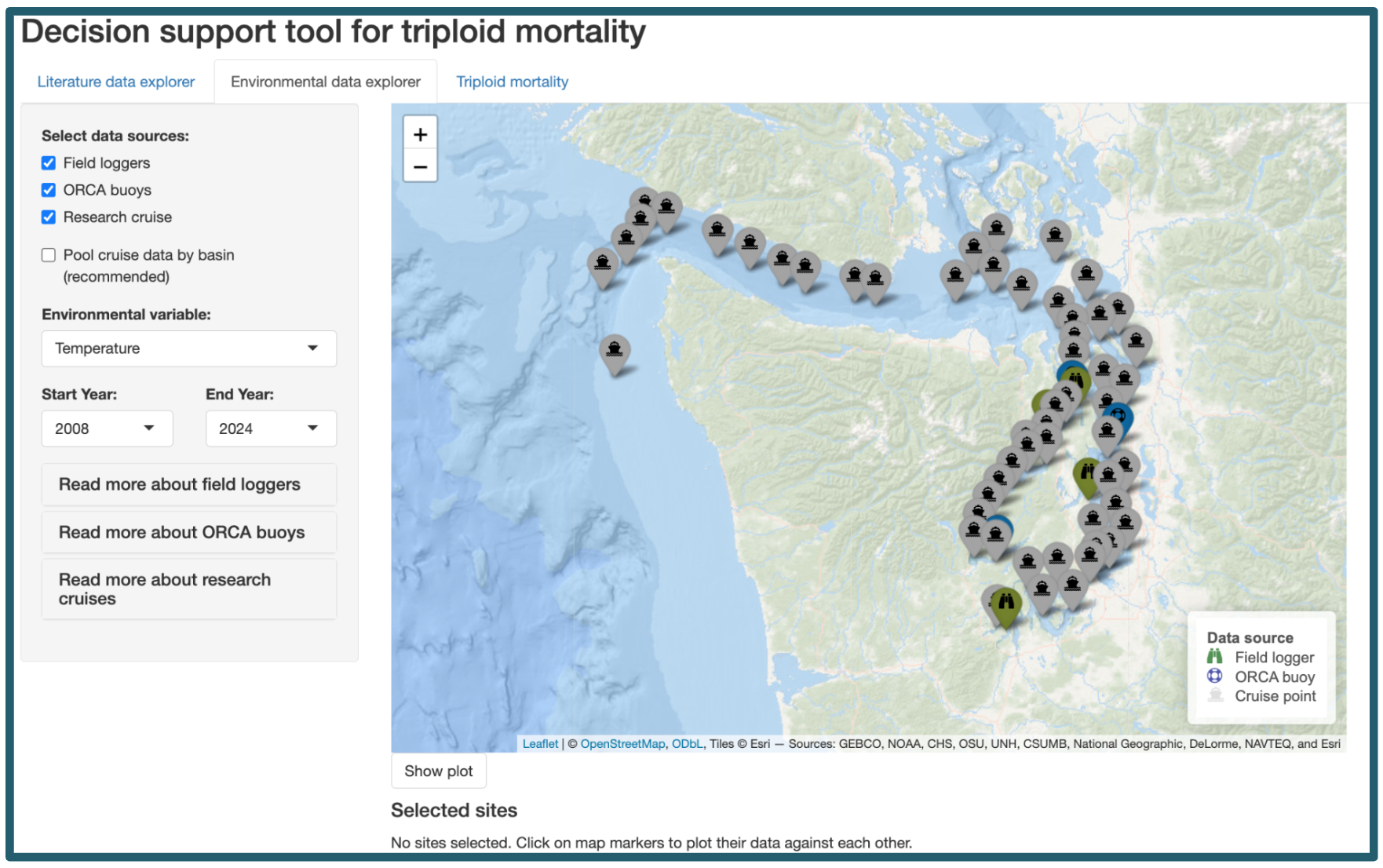
To help farmers choose between planting diploids and triploids, Kiran developed an online decision-support app using R Shiny. The app has three different tabs:
- The first tab allows users to explore recent research and data on triploid mortality.
- In the second tab, users can use a clickable map of Puget Sound to identify environmental data sources near their farm. Data include temperature, salinity, and dissolved oxygen.
- In the third tab, users can test locations around Puget Sound while linking triploid mortality to temperature using a model. Users receive information on the likelihood of triploid mortality at their selected location.
While still a work in progress, the app presents users with the best available data on triploid mortality and gives them a broad understanding of trends and the literature.
Getting out to the farms
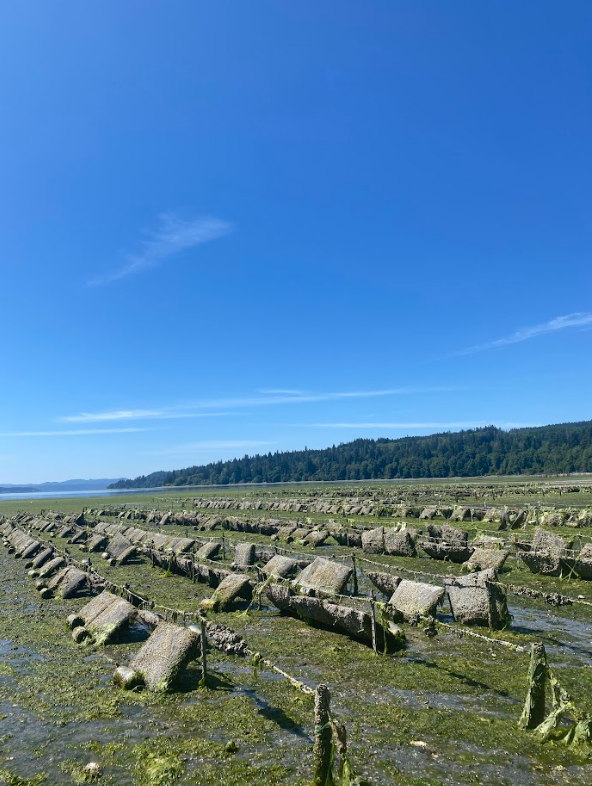
When Kiran was not at the Northwest Fisheries Science Center coding away on the app, she got out to some oyster farms to conduct fieldwork with postdoc Craig Norrie, Ph.D. at the University of Washington. Craig’s experiments assess growth, survival, and physiological differences between diploids and triploids, and provide the type of data that will be especially useful for the app.
By working on the farms, Kiran gained a first-hand view of how the app might help farmers, observed and measured triploids growing in the intertidal, and enjoyed the scenery of Thorndyke Bay and Eld Inlet. Kiran is excited to keep improving the app throughout the fall and get it into the hands of farmers as soon as possible.
Kiran Bajaj, 2023 Hollings scholar
Kiran is a 2023 Hollings scholar studying marine biology at Northeastern University.