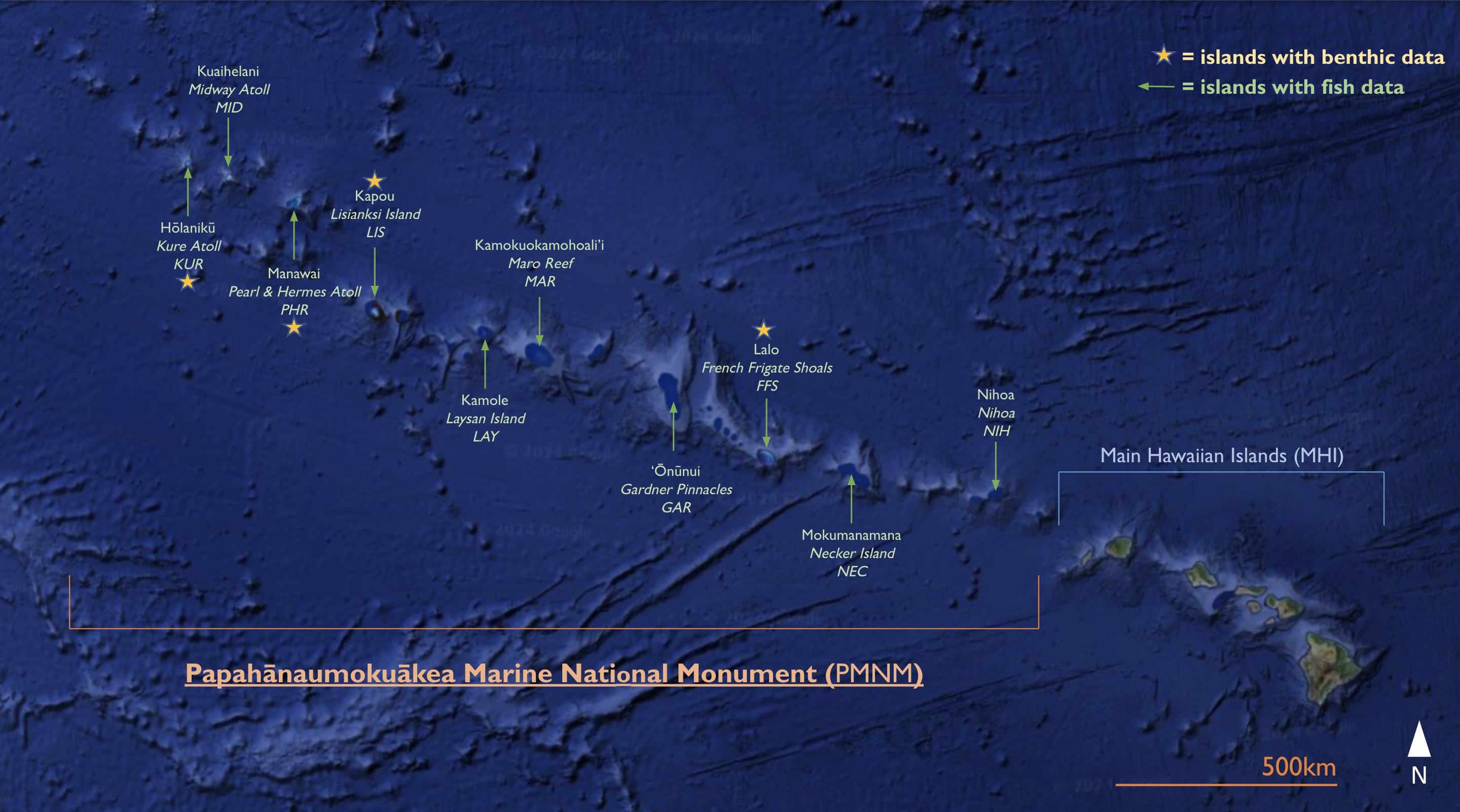

Khrista Nicholas, a 2023 Hollings scholar, spent her summer in Honolulu, Hawaiʻi, working with the NOAA Papahānaumokuākea Marine National Monument (PMNM) team. For decades, researchers have made expeditions to collect data about this hub of cultural and ecological significance that spans the Northwestern Hawaiian Islands. Khrista learned how to use a programming language called “R” to analyze this expansive dataset looking for hidden gems of knowledge about where fish and benthic species live and interact across the monument. Her findings suggest that each island supports a unique ecosystem and may have a different standard of what healthy looks like.
About Papahānaumokuākea Marine National Monument
PMNM is one of the world’s largest marine conservation areas and is currently being proposed for sanctuary designation. Largely undisturbed by local human development, it holds high biodiversity and species not found elsewhere. Khrista’s research project dug into this data to conduct an updated biogeographic assessment of PMNM.
Khrista's project
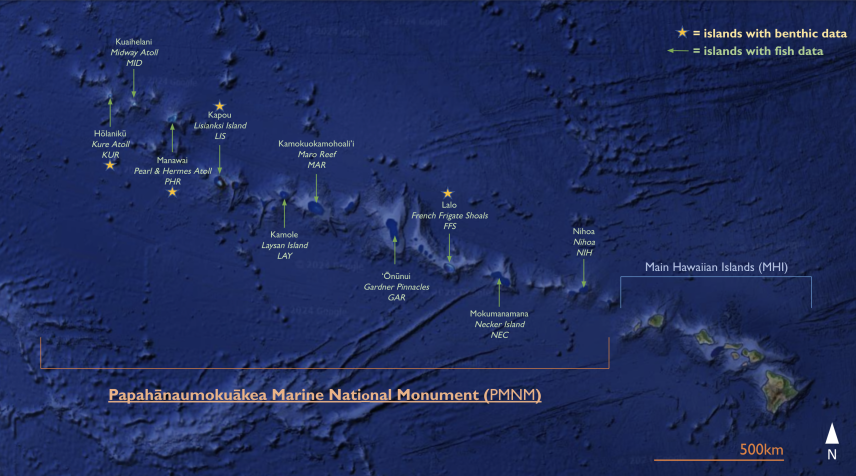
Using the R coding language, Khrista identified patterns and created visualizations that represent the benthic and reef fish populations across the monument. The data highlighted the distribution of coral and algae, the large abundance of herbivorous fish, and high number of reef fish whose species are unique to these communities.
Khrista’s results also support that PMNM is an interconnected web of coral reef ecosystems, with each island having a unique profile of fish populations, benthic cover, and environmental conditions. Recognizing the unique ecosystem of each island is key to improving monitoring efforts of PMNM ecosystems.
Next steps
Khrista hopes that her project will be a platform to continue investigating questions about PMNM that remain unexplored. She aims to understand the impact of climate change on marine ecosystems, their dynamic ocean environment, and the communities intertwined with them. Following graduation from the University of Miami, she plans to attend graduate school to continue pursuing research she is passionate about.
Khrista Nicholas, 2023 Hollings scholar
Khrista is a class of 2023 Hollings scholar and a Marine Science major at University of Miami.